Standardizing CNC Machine Setups
A Simple Guide to Boosting Efficiency and Cutting Downtime.Transform unpredictable, stressful job changes into a fast, repeatable, and high-profit process.
Table of Contents
If you run a CNC machining shop or manage machine operators, you know that keeping your machines running is key to making a profit. When a CNC machine is cutting metal or plastic, it creates value. Specifically, when a CNC machine is cutting metal or plastic, it creates immediate value for your business. However, when that machine sits idle while an operator searches for a wrench… money is lost.
Standardizing your CNC machine setups transforms unpredictable, stressful job changes into a fast, repeatable process. This guide covers everything needed to standardize CNC setups across a shop floor, using clear, plain language that anyone on the team can follow.

Why Standardizing CNC Setups Matters
Setups directly impacts shop productivity, part accuracy, and operator morale:
Drastically Reduced Downtime: First, shops that standardize setup procedures experience drastically reduced downtime, often cutting changeover times by 30% to 50%.
Fewer Scrapped Parts: Second, following a standardized checklist leads to fewer scrapped parts because operators catch misaligned fixtures…
Easier Operator Training: Additionally, training new hires becomes much easier…
Better Machine Utilization: Furthermore, your CNC machines…
Safer Work Environment: Finally, establishing clear procedures creates…
The Hidden Costs of Non-Standard Setups
When shop floors lack standard setup routines, common hidden wastes repeatedly surface:
- The “Search and Find” Waste: For example, operators waste 15 to 20 minutes. walking around looking for clamps, indicator bases, collets, or setup sheets.
- Trial-and-Error Adjustments: In addition, guessing workpiece offsets or test-cutting without standard measurements wastes material and machine time.
- Shift-Change Friction: Consequently, night-shift operators because “that’s not how I do “
- Tribal Knowledge Risk: Above all, relying on tribal knowledge means If they call in sick, production halts.
5 Steps to Standardize Your CNC Setups
Applying lean setup reduction techniques (often called SMED, or Single-Minute Exchange of Die) provides a clear 5-step roadmap:
1: Separate Internal and External Setup Tasks
Divide all setup activities into two distinct categories:
Specifically, you must divide all setup activities into two distinct categories:
External Tasks: First, external tasks are activities done while the machine is still running…
Internal Tasks: Second, internal tasks are activities done only when the machine is completely stopped…
Goal: Complete all external tasks BEFORE stopping the machine for the new job.
2: Organize Workstations with a 5S System
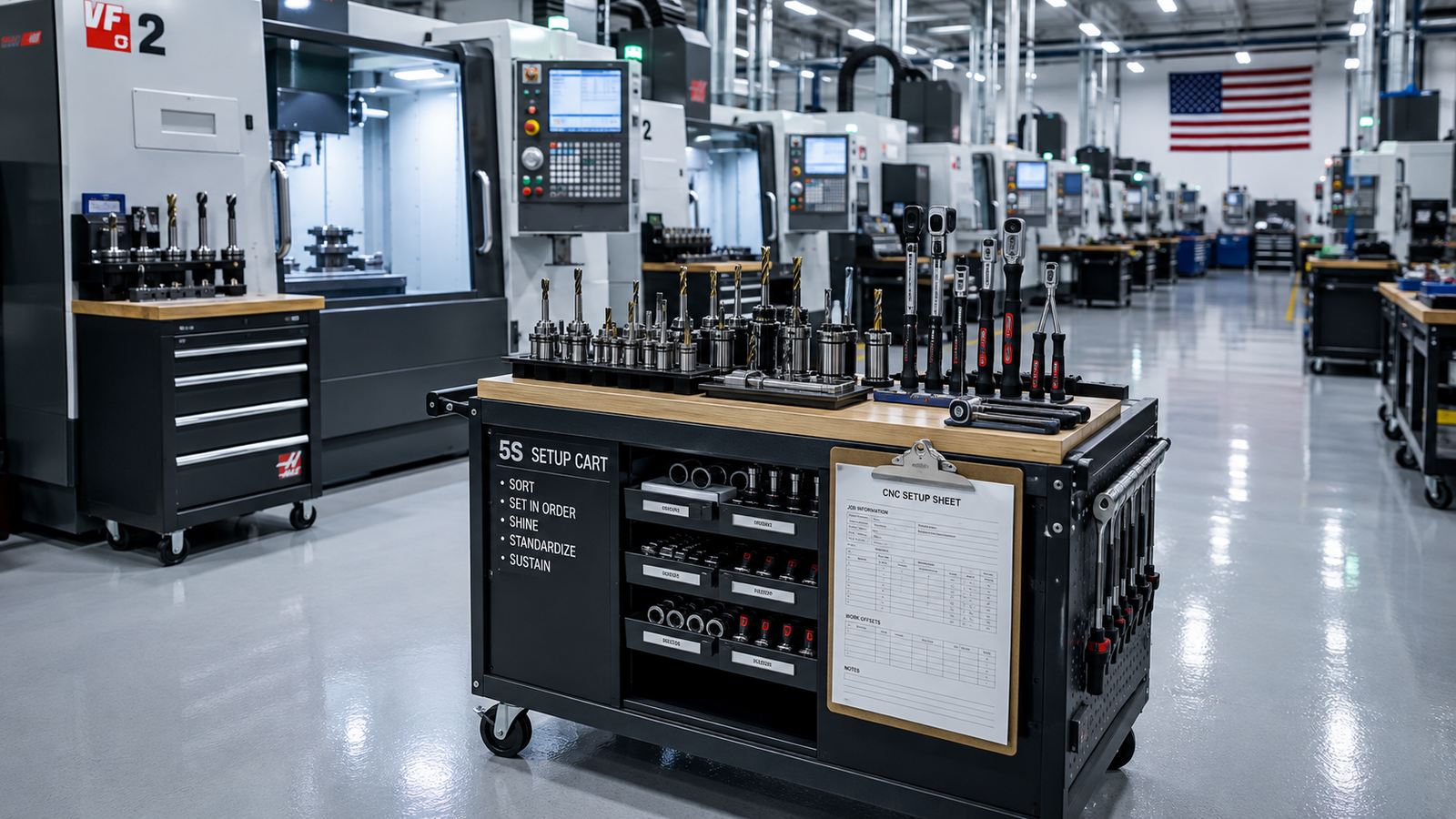
Provide a dedicated setup cart or drawer for essential tools (torque wrenches, dead-blow hammers, deburring tools, clean rags). Use shadow boards for wrenches and allen keys so missing tools are noticed immediately — the same organizing principle we cover in our shop floor management guide.
3: Create Clear, Visual Setup Sheets
Ditch multi-page, wordy manuals. Build single-page visual setup sheets containing high-resolution photos showing fixture orientation, precise work offset locations (G54, G55), required tool numbers, collet sizes, stickout lengths, and specific torque settings. A digital setup sheet system makes this far easier to maintain and update than printed pages that go stale the moment a process changes.
4: Adopt Modular and Quick-Change Fixtures
Replacing traditional bolt-down setups with modular sub-plates or quick-change receiver systems speeds up table prep. Instead of spending 30 minutes dialing in a vise with an indicator, a modular pin-locating system places the fixture within microns in seconds.
5: Tooling and Offsets
Standardize tool library numbers across similar machines (e.g., Tool 1 is always a 1/2-inch end mill). Use an off-line tool presetter to measure tool lengths and diameters before tools reach the machine, and use touch probes to set work coordinates automatically. A connected tool crib system makes it much easier to keep this standardization consistent across every machine instead of relying on individual operators to remember the convention.
Standardized CNC Setup Checklist
To help operators follow the standard every day, print out or digitize this 3-phase checklist. Our full CNC setup sheet checklist covers this in more detail if you want a ready-to-use template.
1: Pre-Setup Tasks (External Tasks — Machine Still Running)
TASK | DESCRIPTION & PROCEDURE | STATUS |
Stage Materials | Raw material inspected, deburred, and placed on the setup cart. | [ ] |
Gather Tooling | All required cutting tools loaded in holders and preset off-line. | [ ] |
Prepare Fixtures | Vise jaws, sub-plates, or custom fixtures cleaned and prepped. | [ ] |
Verify Program | CNC program verified in CAM software and loaded onto control. | [ ] |
2: Active Setup Tasks (Internal Tasks — Machine Stopped)
TASK | DESCRIPTION & PROCEDURE | STATUS |
Clean Table | Wipe down machine table, T-slots, and fixture base surfaces clean. | [ ] |
Mount Fixtures | Secure fixtures to known locating pins or indicate to tolerance (<0.01mm). | [ ] |
Load Tools | Insert pre-measured tool holders into designated magazine pockets. | [ ] |
Set Offsets | Load tool offsets (H/D) and work coordinates (G54-G59) accurately. | [ ] |
Dry Run Check | Run single-block dry run with +50mm Z-offset to confirm clearances. | [ ] |
3: Post-Setup Verification & Quality Sign-Off
TASK | DESCRIPTION & PROCEDURE | STATUS |
First Article Cut | Run first part using feed rate override at 50% while monitoring chips. | [ ] |
Inspect Part | Measure critical tolerances with calibrated gauges against specs. | [ ] |
Sign Off | Operator and QA sign off on setup sheet before full production run. | [ ] |
Simple Metrics to Measure Improvement
In order to check if setup standardization is working, track three simple metrics… Ultimately, standardizing CNC machine setups is not about micromanaging… Because everyone works from the same playbook… Therefore, start small with one machine
1. Setup Time (Changeover)
Total time measured from the last good part of Job A to the first good part produced in Job B.
2. First-Pass Yield (FPY)
Percentage of first parts produced immediately following a setup that meet quality specs without rework.
3. Equipment Effectiveness (OEE)
Overall efficiency score tracking how much planned production time is genuinely productive — the same core metric we cover in our Machine Shop ERP analytics and KPI guide.

Conclusion
Standardizing CNC machine setups is not about micromanaging operators or taking away their craft; it is about removing everyday frustration, eliminating unnecessary walking across the shop floor, and making work significantly easier and safer. When your entire machining team operates from the same structured playbook, setup times become drastically faster, part dimensions stay consistently accurate, and your entire shop floor runs smoother every single day.
Start small — standardize one machine first, prove it works, then roll the same playbook out across the floor. If you’re ready to go beyond paper checklists, our digital Setup Sheet Application builds this standardization directly into your workflow rather than relying on printed sheets that go out of date
Frequently Asked Questions
Pick one machine and one recurring job type, document the current setup as external vs. internal tasks, and build a single-page visual setup sheet for it before expanding to other machines.
Paper checklists work as a starting point. The limitation is keeping them updated — a digital system makes it much easier to roll out a process change to every machine at once instead of reprinting and redistributing sheets.
Most shops see measurable changeover time improvements within the first few standardized jobs, since the biggest gains usually come from simply separating internal and external tasks — the core idea behind SMED.
Call to Action
If you want to customize standardized visual setup sheets, audit your current machine setup routines, or implement a lean SMED process in your facility, contact our manufacturing engineering team today for a free workflow audit

We help your business grow with powerful SaaS solutions
Resources
© 2026 Texono. All rights reserved.