Industry 4.0 for Machine Shops: A Simple Guide to Smart Manufacturing
Learn how Industry 4.0 transforms machine shops. Discover connected CNCs, real-time machine monitoring, IIoT, and predictive maintenance in simple terms. |
Table of Contents
1. Introduction: The Morning Spindle Surprise
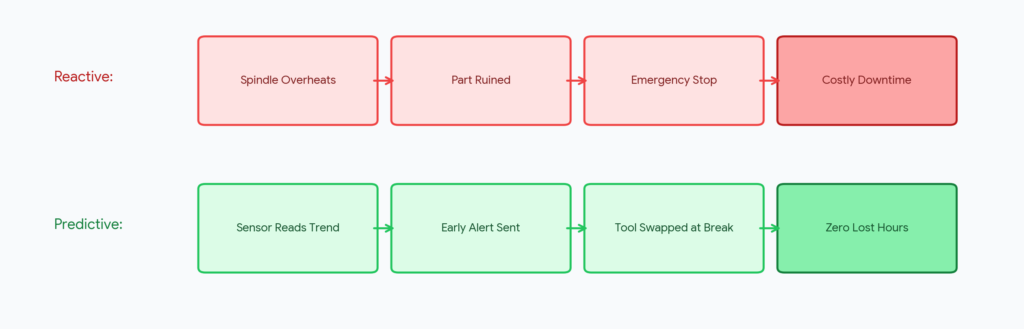
It is 7:30 AM on a Tuesday. Your shop is rushing a critical 500-piece aerospace bracket order due Friday. Forty minutes in, CNC Mill #3 alarms out: an unmonitored carbide end mill overheated, vibrated excessively, and welded into the workpiece. The result is a ruined part, a broken tool, two hours of lost production, and an urgent call to an anxious customer.
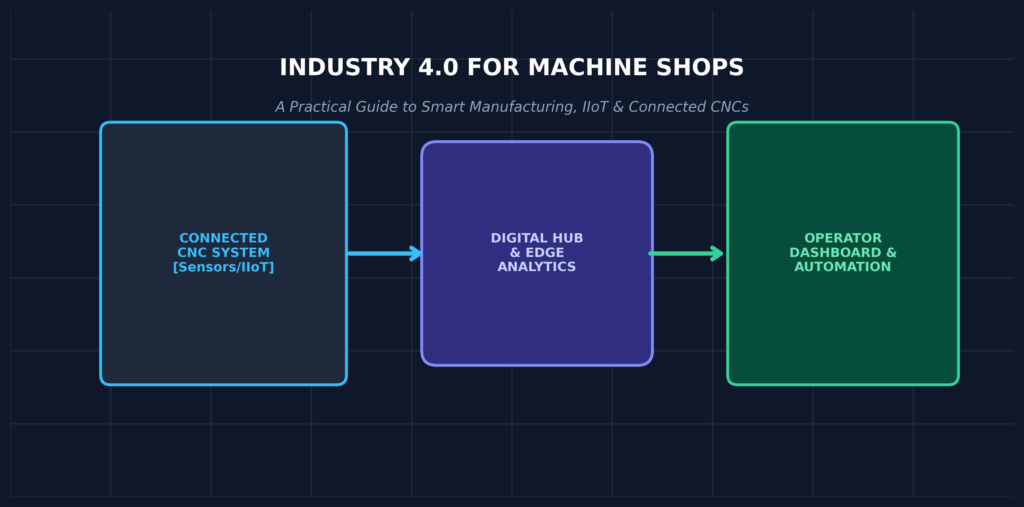
For decades, machine shops have operated in this reactive mode—relying on manual clipboards and guessing why machine utilization is low. **Industry 4.0 for machine shops** changes this. Smart manufacturing connects machines, sensors, and software to provide real-time visibility into every cut.
📌 Quick Takeaways |
2. What Is Industry 4.0? (The 4 Revolutions)
Manufacturing has evolved through four key stages. While Industry 3.0 brought digital computers to individual machines, Industry 4.0 networks them together to share real-time telemetry.
Revolution | Key Technology | Shop Floor Impact |
Industry 1.0 (1700s) | Steam & Water Power | Mechanical machinery replaced manual labor. |
Industry 2.0 (1800s) | Electricity & Assembly Lines | Mass production and electric motor line shafts. |
Industry 3.0 (1900s) | Computers & PLCs | Early CNC controls and automated memory. |
Industry 4.0 (Today) | IIoT, Cloud & Live Data | Connected CNCs, predictive maintenance, and digital dashboards. |
Despite how far the technology has come, adoption still lags: a 2026 benchmark report covered by Advanced Manufacturing found that 78% of manufacturers still haven’t fully integrated Industry 4.0 into their operations — so a shop starting this journey now isn’t behind, it’s actually in the majority.
3. Core Technologies inside a Smart Machine Shop
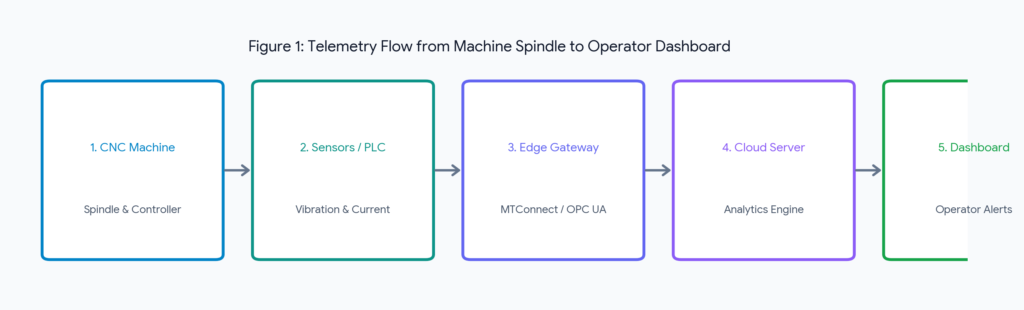
- IIoT & Open Protocols (MTConnect / OPC UA): Connects CNC controllers to local networks to stream spindle load, feed rates, and part counts automatically.
- Smart Sensors: External magnetic vibration and current clamps monitor legacy machines without voiding warranties or altering control boards. Retrofit approaches like this are increasingly common since fewer than 30% of manufacturers currently use IIoT extensively, and replacing working equipment just to add connectivity rarely makes economic sense.
- Real-Time Machine Monitoring: Tracks cycle starts and stops down to the second, replacing handwritten shift logs — the same kind of visibility covered in our guide to real-time shop floor tracking.
- Predictive Maintenance: Analyzes thermal and acoustic trends to replace worn components before catastrophic crashes occur.
- Collaborative Robots (Cobots): Safe robotic arms handle repetitive CNC tending and deburring, freeing machinists for complex setup tasks.
- Digital Twins: Virtual 3D simulations replicate exact machine kinematics to verify G-code and prevent collisions before metal is cut.
Maintenance Strategies Compared
Strategy | Trigger Mechanism | Operational Outcome |
Reactive | Machine breaks down / tool fails. | High unplanned downtime, scrap, and emergency repair costs. |
Preventive | Fixed calendar interval (e.g., 90 days). | Better reliability, but often replaces good parts prematurely. |
Predictive | Live sensor condition (vibration/heat). | Zero unexpected crashes; maximizes tooling and component lifespan. |
4. Traditional Machine Shop vs. Smart Machine Shop
Operational Area | Traditional Machine Shop | Industry 4.0 Connected Shop |
Machine Tracking | Manual paper logs filled at shift end. | Automated IIoT streaming real-time spindle metrics. |
Downtime Alerting | Discovered after hours of lost production. | Instant SMS/email notification the moment a tool stalls. |
Maintenance | Run-to-failure or rigid calendar schedules. | Predictive condition tracking based on live sensor data. |
Quality & Offsets | End-of-batch manual CMM inspection. | In-process touch probing with automated tool offsets. |
Program Delivery | Operators walk USB thumb drives across floor. | Centralized DNC pushing verified CAD/CAM G-code directly. |
Traceability | Filing cabinets full of physical paper sheets. | 100% digital serial-number records stored securely in cloud, the same shift we cover in why machine shops are going paperless |
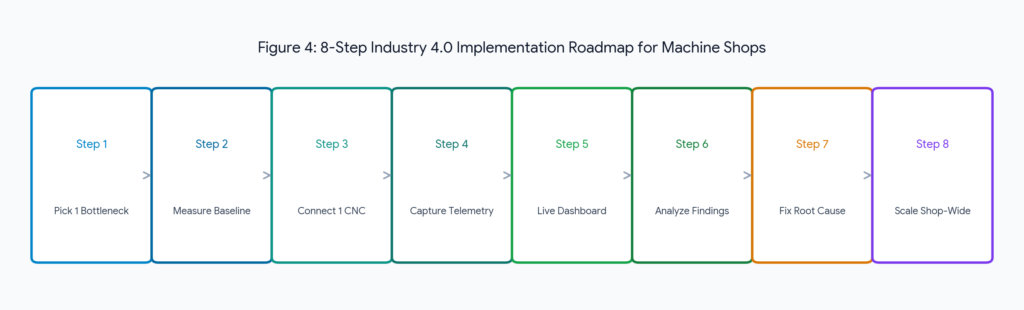
5. How to Start in a Small Shop (8-Step Roadmap)
Small and medium job shops do not need to overhaul everything at once. Follow this practical, phased approach:
- Step 1: Identify One Bottleneck — Select the single machine or process causing the most scheduling delays.
- Step 2: Measure Baseline — Log true spindle uptime and setup delays for two weeks to establish a baseline.
- Step 3: Connect 1 Machine — Install an IIoT adapter or simple current clamp on the bottleneck work center.
- Step 4: Capture Telemetry — Stream live spindle status, error codes, and cycle counts to a local network gateway.
- Step 5: Live Dashboard — Mount an inexpensive tablet or shop monitor displaying live status.
- Step 6: Review Weekly — Collaborate with machinists to identify why idle periods and micro-stoppages occur.
- Step 7: Fix Root Causes — Standardize setup carts, optimize CAM routines, and adjust tooling wear limits using digital setup sheets instead of memory or paper.
- Step 8: Scale Gradually — Roll out sensors to adjacent machine cells once the pilot proves positive ROI.
6. Key ROI Metrics & Common Mistakes to Avoid
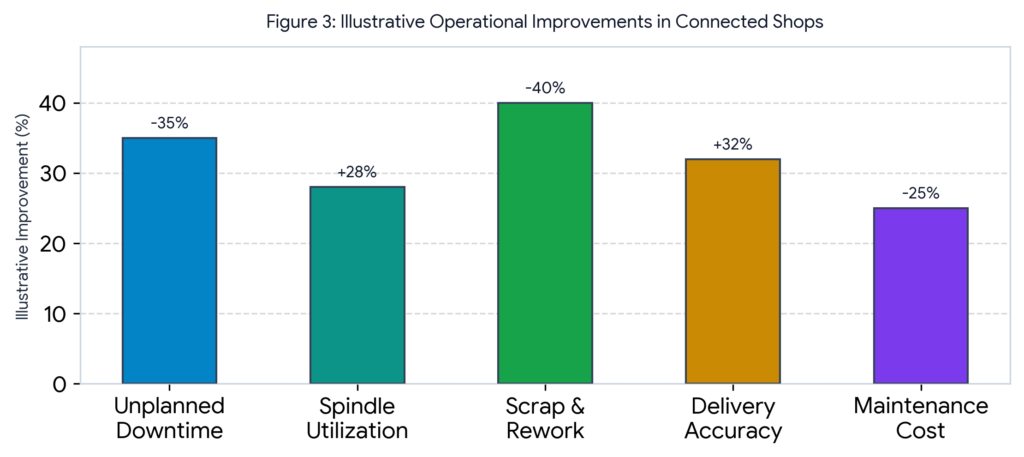
- OEE (Overall Equipment Effectiveness): Availability × Performance × Quality score measuring overall asset performance.
- Spindle Utilization (%): Actual cutting time vs. scheduled shift time; reveals hidden capacity without buying new CNCs.
- Unplanned Downtime: Tracks reduction in mechanical and tool crash hours.
- Scrap Rate (%): Measures in-process consistency and reduction of dimensional rework.
These are the same core metrics covered in our Machine Shop ERP analytics and KPI guide — Industry 4.0 sensors generate the raw data, but it still needs a system to turn that data into decisions.
Top Mistakes to Avoid:
- Buying software without a clear problem to solve • 2. Trying to connect every machine overnight • 3. Failing to involve machinists early • 4. Collecting data without taking action • 5. Ignoring basic VLAN network security.
7. Frequently Asked Questions (FAQ)
Q: Can we connect 15- to 20-year-old legacy CNCs?
A: Yes. Non-invasive external sensors (vibration accelerometers, current clamps, optical stack light sensors) connect older machines for under $500.
Q: Does Industry 4.0 replace machinists?
A: No. It eliminates tedious paperwork and manual logging, allowing skilled machinists to focus on setups, programming, and quality.
Q: How much does a pilot project cost?
A: Connecting 1 to 3 CNCs with plug-and-play IIoT hardware typically starts under a few thousand dollars and provides immediate operational visibility.
🚀 Start Your Smart Manufacturing Pilot |
Call to action
Ready to modernize your shop floor without the complexity?
Don’t overhaul everything at once — start with a single machine. Identify your biggest bottleneck, set up a low-cost IIoT pilot, and start seeing real-time spindle visibility this week.
Connected sensor data is only half the picture — it needs somewhere to go. Texono’s Machine Shop ERP ties real-time machine data into scheduling, costing, and shop floor management, so the visibility you gain from an Industry 4.0 pilot actually drives decisions instead of sitting in a separate dashboard.

We help your business grow with powerful SaaS solutions
Resources
© 2026 Texono. All rights reserved.