
Manufacturing ERP Software Features Every Manufacturer Should Look For in 2026
Tired of bloated software quotes? Here are the 10 real manufacturing ERP that drive floor through in 2026 real cost and migration tips.
Table of Contents

Manufacturing ERP Software Features Every Manufacturer Should Look For in 2026
The Reality Check: If you’ve spent any time on a factory floor lately, you know the drill. A supervisor is chasing down missing material components, an operator is re-keying production batch data into three different spreadsheets, and the leadership team is staring at a inventory variance report that’s already two weeks out of date.
It’s exhausting. And in 2026, it’s completely unnecessary.
We’ve officially passed the era where an ERP system was just a fancy, expensive GL accounting ledger connected to a static inventory database. Modern manufacturing moves too fast, customer order sizes are too customized, and supplier lead times remain too unpredictable. If your software isn’t actively helping your plant floor adjust on the fly, it’s not enterprise software—it’s organizational dead weight.
Let’s break down the 10 core features that actually matter when evaluating a manufacturing ERP this year, along with real numbers, floor scenarios, and implementation traps to avoid.
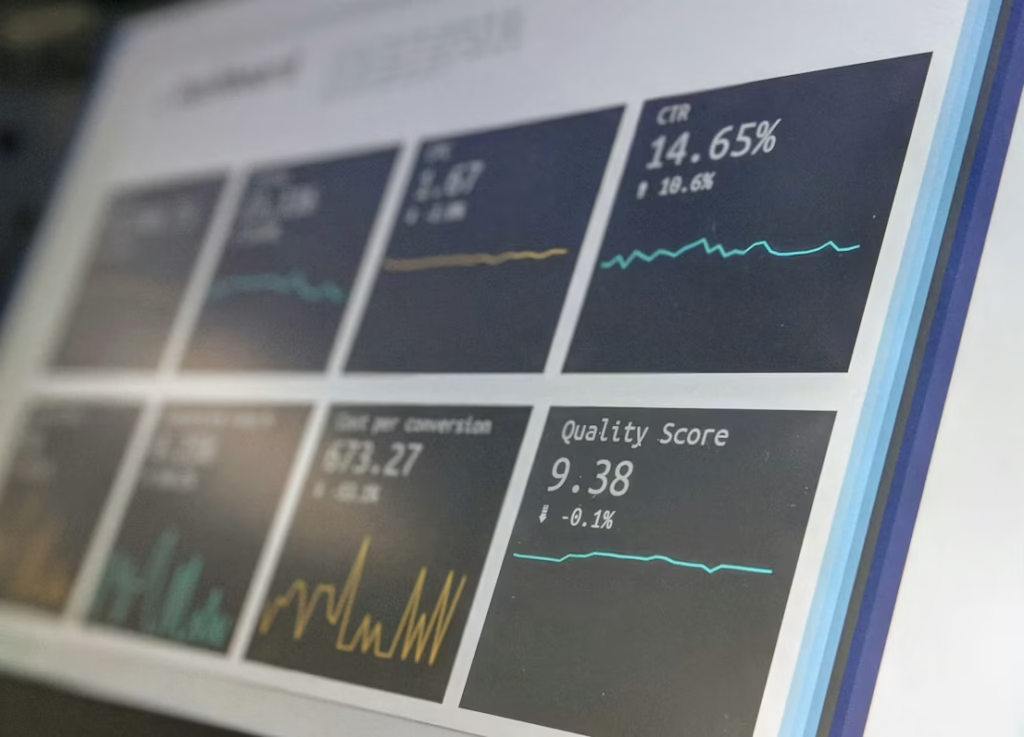
Visual Insight: Factory Floor Realities in 2026
1. Predictive Demand Sensing & Dynamic Scheduling
Traditional Material Requirements Planning (MRP) was built on simple math: take historical sales, apply a fixed lead time, and spit out purchase orders. But what happens when an unexpected shipping delay hits or a key customer spikes their order volume by 40% overnight? The old math breaks.
In 2026, modern ERPs use machine learning to constantly recalculate safety stock and reschedule work orders based on live data—including actual vendor shipping times, equipment availability, and order urgency. It turns your scheduling from a weekly panic session into an automated, fluid calendar.
2. IoT Machine Links & Real-Time Shop Floor Control
Here is a simple rule for 2026: if your machine operator has to step away from their workstation to manually write down cycle counts or scrap reason codes on a clipboard, your data is already flawed.
Modern ERP platforms plug directly into machine Programmable Logic Controllers (PLCs) via lightweight IIoT protocols (like OPC UA or MQTT). The system logs Overall Equipment Effectiveness (OEE), line speed, and downtime triggers automatically. You get instant visibility without adding paperwork to an already busy shop floor.
3. In-Line Statistical Process Control (SPC)
Catching a defect during final packaging is a waste of time and raw material. Next-generation ERPs integrate quality management directly into production runs. When a machine’s tolerances begin to drift—even by a fraction of a millimeter—the system flags the operator or automatically pauses the work order before you produce three pallets of scrap.
4. Multi-Tier Vendor Portals & Supply Chain Tracking
Knowing when your direct supplier ships a raw material shipment isn’t enough anymore. You need eyes on Tier 2 and Tier 3 suppliers. Modern ERP platforms offer clean, self-service portals where vendors confirm orders, update lead times, and post Advance Shipping Notices (ASNs). If a critical component gets stuck at a port, your system recalculates floor priorities instantly.
5. Live Job Costing & Dynamic Margin Tracking
With fluctuating utility prices, shifting shift differentials, and changing raw material surcharges, standard costing models become outdated fast. Continuous ERP costing updates job costs in real time as labor hours, energy consumption, and raw materials are consumed. You can see exact order profitability before the product even leaves the loading dock.
Market Data: Where ERP Projects Win or Stall
Before covering the remaining features, let’s look at the current industry benchmarks. Understanding where other plants struggle helps focus software priorities where they deliver real return on investment:
Operational Metric / Benchmark | 2026 Industry Average | Impact on ERP Selection |
Global ERP Market Growth | $59.4 Billion annual spend | Massive vendor shift toward industry-specific vertical modules. |
Cloud Deployment Share | 70.4% of total deployments | On-premise legacy systems are rapidly becoming unmaintainable. |
Implementation Failure Rate | 55% – 75% fail to hit original ROI | Root cause is usually poor floor adoption and messy historical data. |
Average Time to Go-Live | 17 Months across mid-market | Modular microservice rollout cuts time-to-value dramatically. |
Average Return on Investment | $1.52 back per $1.00 spent | Highest gains come from inventory reduction & scrap elimination. |
6. Cloud Microservices & Edge Floor Resilience
A cloud-native ERP doesn’t mean your factory stops working if your internet drops for twenty minutes. Leading systems use a hybrid edge architecture: core data stays securely synced in the cloud, but localized shop floor terminals run on local edge servers. Your assembly line keeps moving no matter what happens to your WAN connection.
7. Native Carbon Accounting & Material Scrap Tracking
Scope 1 and Scope 2 emission reporting isn’t just a corporate compliance burden anymore—it’s built right into customer procurement contracts. Modern manufacturing ERPs automatically calculate the energy and raw material carbon footprint per completed batch, letting you turn sustainability into a competitive selling point.
8. AI Predictive Maintenance (PdM)
Unplanned machine downtime wipes out profit margins faster than almost anything else. By tying asset management directly into vibration and thermal sensors, the ERP generates maintenance tickets automatically before a gearbox seizes—and schedules that maintenance during natural job changeovers.
Floor Readiness & Evaluation Checklist
When evaluating software vendors, use this functional matrix to cut through product demos and focus on real shop floor capabilities:
System Capability | What to Look For in Demos | Floor Priority Level |
Floor Automation | Native IIoT PLC polling (OPC UA/MQTT) without third-party middleware | Critical / Must-Have |
Schedule Agility | Dynamic constraint-based rescheduling during active machine downtime | Critical / Must-Have |
Quality Control | Automated non-conformance logging (NCR) tied directly to batch runs | High Priority |
Cost Transparency | Real-time variance tracking per work order during active production | High Priority |
Usability & UX | Operator terminals that require less than 15 minutes of training time | Critical / Must-Have |
The Bottom Line for 2026
An ERP upgrade should never be viewed as just an IT migration project. It is an operational decision that directly impacts floor throughput, scrap rates, customer lead times, and gross margin. Don’t let flashy sales decks distract you from what your plant floor actually needs to run efficiently every day.
Operational Action Plan |
Call to action
Ready to simplify your manufacturing operations? See how our Manufacturing ERP Software can help you manage production, inventory, purchasing, and reporting from one platform.